Your Ultimate Guide to Stocks & Global Markets
What Are Analyst Ratings
A retail investor’s guide to stock signals
6/12/2026
When navigating the stock market, retail investors are bombarded with data: price charts, earnings reports, macroeconomic indicators, and technical signals. Among the most visible and influential pieces of information are Analyst Ratings.
But what exactly do these ratings mean, and how should a smart investor use them? Here is a breakdown of how Wall Street's "weather forecast" works.
What is an Analyst Rating?
An analyst rating is a formal recommendation issued by a financial analyst—usually working for an investment bank or an independent research firm—regarding whether a specific stock is a good investment.
These analysts spend their days diving deep into corporate financial statements, interviewing management teams, tracking industry trends, and building complex financial models. The culmination of this research is summarized into a single, easy-to-understand recommendation, usually accompanied by a Price Target (the analyst's estimate of where the stock price will be in 12 months).
Decoding the Lingo: The Big Three
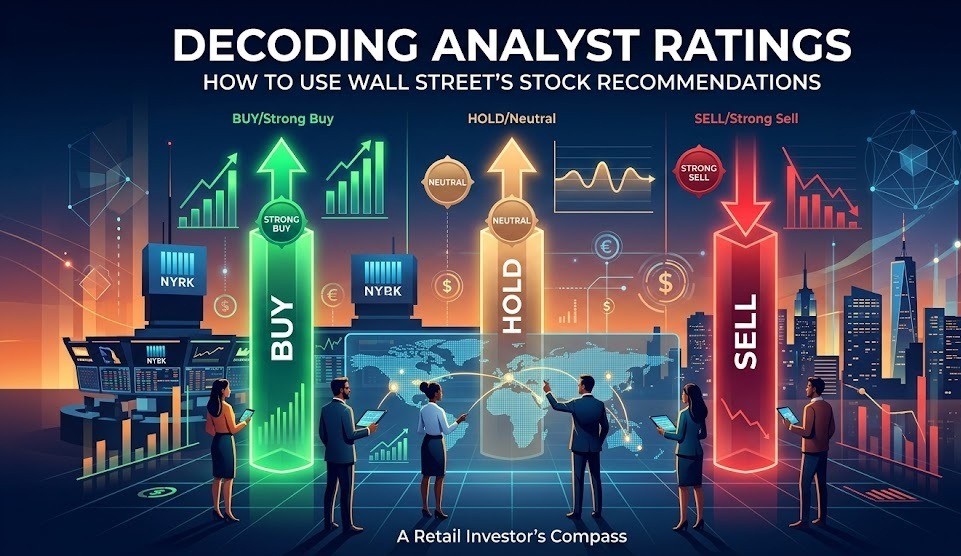
While different financial institutions use different jargon, almost all ratings fall into three core categories:
The Green Light: Buy / Strong Buy The analyst believes the stock is undervalued and will significantly outperform the broader market or its sector over the next 6 to 12 months. Alternative terms often used include Outperform, Overweight, or Accumulate.
The Yellow Light: Hold / Neutral The analyst expects the stock to perform in line with the market average. It essentially signals to investors: "If you own it, don’t panic-sell, but if you don't own it, don't buy it just yet." It is also referred to as Market Perform or Equal Weight.
The Red Light: Sell / Strong Sell The analyst anticipates that the stock’s price will drop or underperform the market. On institutional platforms, this might be labeled as Underperform or Underweight.
The Power of the Consensus Rating
Looking at a single analyst’s opinion can be risky. That is why smart investors look at the Consensus Rating. This is the aggregate or average rating compiled from all the Wall Street analysts covering a specific stock.
For instance, when a stock is covered by dozens of analysts and the vast majority maintain a "Buy" recommendation, the consensus is strongly bullish. Conversely, if the ratings are evenly split across Buy, Hold, and Sell, it indicates that the broader market is highly undecided about the company's near-term future. Tracking the shift in this consensus over time provides a much clearer picture of institutional market sentiment.
Reading Between the Lines: What Investors Need to Know
While analyst ratings are valuable, they are not infallible crystal balls. To use them effectively, you must understand the unwritten rules of Wall Street:
The "Hold" Paradox: Wall Street analysts are notoriously reluctant to issue outright "Sell" ratings. Doing so can anger the company's management, costing the analyst's bank lucrative investment banking contracts. Therefore, a downgrade from Buy to Hold is often interpreted by savvy investors as a polite way of saying Sell.
The Lagging Effect: Analysts are often reactive rather than proactive. They frequently upgrade a stock after it has already rallied, or downgrade it after bad news has already broken and the stock has crashed.
Conflicts of Interest: Always check who is issuing the rating. "Sell-side" analysts work for firms that manage money or underwrite stocks, which can introduce bias. "Buy-side" or independent analysts are often considered more objective because they don't have skin in the game.
The Bottom Line
Think of analyst ratings as a useful starting point for your research, not a final destination. Use them to understand market sentiment and to see what the "smart money" is thinking, but always combine them with your own fundamental analysis before hitting the buy or sell button.
Capital at Risk. Investing involves risk. The content of this site is for informational and educational purposes only and does not constitute investment advice.
Copyright © 2026 AevumX Capital | All rights reserved.