Your Ultimate Guide to Stocks & Global Markets
The S&P 500
The Barometer of the Global Economy
3/26/2026
The S&P 500 index, or Standard & Poor's 500, is one of the most important and widely followed stock market indices in the world. Essentially, it serves as a barometer for the health of the U.S. economy, as it includes 500 of the largest companies listed on U.S. stock exchanges.
The composition of the index is not static. It includes companies from all major sectors of the economy, such as technology, healthcare, finance, and industry. To be included in the S&P 500, a company must meet specific criteria, including its market capitalization, share liquidity, and profitability. Selection is handled by a committee, which ensures that the index remains representative of the overall market.
The S&P 500 is a market-capitalization-weighted index. This means that larger companies have a greater impact on the index's performance. For instance, if a giant corporation like Apple or Microsoft experiences a significant rise or fall, it will affect the course of the S&P 500 much more than a smaller company would.
The history of the S&P 500 dates back to 1923, when the Standard Statistics Company created its first stock index, which included 233 companies and was calculated weekly. In 1926, this index expanded to 90 companies and began to be calculated on a daily basis.
The modern version of the index, featuring 500 companies, was launched on March 4, 1957. Its creation was made possible by the use of computers, which allowed for the rapid and continuous calculation of the index. At that time, the index primarily consisted of industrial, utility, and railroad companies, reflecting the structure of the U.S. economy during that era.
Over the years, the composition of the S&P 500 has changed radically, keeping pace with shifts in the economy. For example, financial companies were added in the 1970s, while in subsequent decades, the technology sector rose to a dominant position.
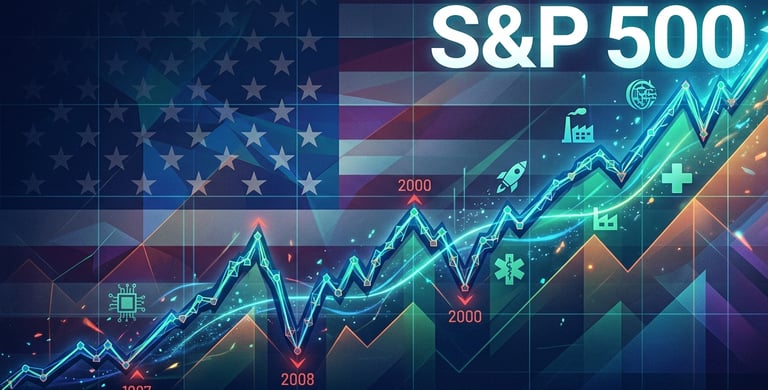
The S&P 500 has weathered many periods of boom and bust, reflecting the economic crises, wars, and technological revolutions that marked the 20th and 21st centuries. Despite temporary fluctuations, it has demonstrated a strong long-term upward trend, offering significant returns to investors.
Today, the S&P 500 is considered the gold standard for measuring the performance of the U.S. stock market. It serves as a benchmark for thousands of investment funds and forms the basis for numerous investment products, such as ETFs (Exchange Traded Funds), which allow investors to purchase a "basket" of the 500 largest American companies in a single move.
Capital at Risk. Investing involves risk. The content of this site is for informational and educational purposes only and does not constitute investment advice.
Copyright © 2026 AevumX Capital | All rights reserved.