Your Ultimate Guide to Stocks & Global Markets
T+1 and T+2
What Does T+1 and T+2 Actually Mean
7/26/2026
Understanding T+1 vs T+2 Dividend Withdrawal Rules
If you have ever received a dividend notification from your brokerage account, navigated to your portfolio to cash out, and found that your funds were locked, you are not alone. This is one of the most common points of confusion for retail investors. You see the money listed in your account balance, yet the option to withdraw it to your bank remains unavailable.
The explanation behind this delay comes down to a core financial market mechanism known as the settlement cycle, commonly denoted as T+1 or T+2.
What Does T+1 and T+2 Actually Mean?
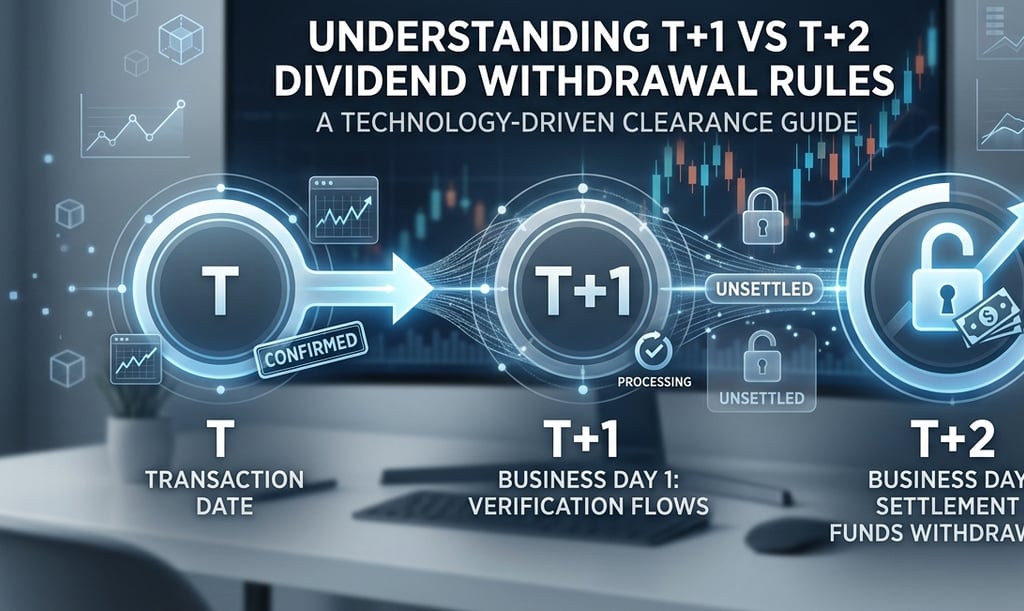
In financial jargon, the letter "T" stands for the Transaction Date. This is the exact day an event occurs—such as the execution of a stock sale or the official payment date of a dividend.
The numbers (+1 or +2) represent the number of official business days required after the transaction date for the trade or payment to fully settle:
T+1 (Transaction Plus One Day): Under a T+1 framework, the settlement process completes exactly one business day after the transaction date. For instance, if a dividend is paid on a Monday, the funds complete final clearance and become fully withdrawable on Tuesday.
T+2 (Transaction Plus Two Days): Under a T+2 framework, settlement requires two business days. If your dividend arrives on a Monday, the formal transfer process finishes on Wednesday, which is when the cash turns into withdrawable funds.
Why Is There a Settlement Delay for Dividends?
When a company distributes dividends, it does not instantly transfer digital cash straight into thousands of individual bank accounts in real time. Instead, the process passes through multiple institutional intermediaries, including clearinghouses, central securities depositories, and custodian banks.
Even though modern technology allows instantaneous data updates—which is why you see the funds reflected in your portfolio balance immediately—the underlying financial verification still takes time. The settlement period ensures that all regulatory checks, tax withholdings, currency conversions, and interbank transfers are verified without risk of default or error.
Practical Example:
Suppose a company pays its dividend on a Friday afternoon, and your brokerage operates under a T+2 settlement cycle. Because weekends do not count as business days, Saturday and Sunday are skipped. Monday counts as T+1, and Tuesday serves as T+2. Consequently, your cash will become withdrawable on Tuesday morning.
Global Shift Toward Faster Settlement Cycles
Financial markets around the globe are actively modernizing their infrastructure to reduce counterparty risk and free up liquidity faster for investors. Major financial markets, including the United States, Canada, and Mexico, officially transitioned to a mandatory T+1 settlement standard in May 2024.
European and UK markets traditionally operate under a T+2 standard, although plans and regulatory frameworks are currently moving toward aligning with the T+1 global standard in the near future.
Key Differences to Keep in Mind
Unsettled Cash vs. Withdrawable Cash: Unsettled cash can often be reused immediately within your brokerage account to buy other stocks, but it cannot be transferred out to your personal bank account until settlement completes.
Business Days Only: Weekends and national market holidays do not count toward your T+1 or T+2 settlement timeline.
Brokerage Policies: Certain brokerages may place additional internal holding periods on fund transfers depending on your account type or deposit history.
Conclusion
Encountering a brief waiting period before withdrawing your dividend payout is a standard safeguard of global financial clearing systems. Understanding whether your assets operate under a T+1 or T+2 timeline helps you plan your cash flows accurately and avoids unnecessary surprises when managing your personal investments.
Capital at Risk. Investing involves risk. The content of this site is for informational and educational purposes only and does not constitute investment advice.
Copyright © 2026 AevumX Capital | All rights reserved.