Your Ultimate Guide to Stocks & Global Markets
Getting to Know the Trader
Learn about the modern financial market merchant
3/14/2026
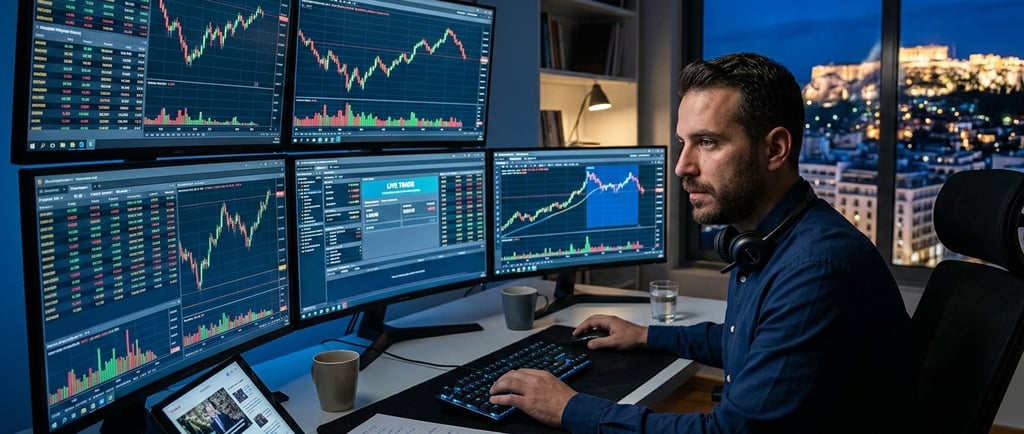
Many people hear the word "Trader" and imagine individuals shouting in front of six screens filled with complex charts.
While that image carries a grain of truth, the world of trading is much more accessible and strategic than it seems. In this article, we will analyze exactly what a trader does, how they differ from an investor, and what someone needs to get started.
Definition: What is a Trader?
In simple terms, a trader is a person who buys and sells financial products with the aim of profiting from price fluctuations. These products may include:
Stocks (e.g., Apple, Tesla)
Currencies (Forex, e.g., EUR/USD)
Cryptocurrencies (Bitcoin, Ethereum)
Commodities (Gold, Oil)
Trader vs. Investor:
What is the difference?
The main difference lies in the time horizon and the mindset.
A Trader focuses on the short term (from seconds to months), aiming for profit through market volatility. Their analysis is primarily Technical, focusing on price charts.
In contrast, an Investor has a long-term perspective (years or decades), aiming for gradual wealth accumulation and dividends. Their analysis is primarily Fundamental, focusing on economic data and company health.
The Basic Types of Traders
Not all traders operate in the same way. They are categorized based on the speed of their movements:
Scalpers: They execute dozens of trades within a single day, holding positions for only seconds or minutes.
Day Traders: They open and close all their positions within the same trading day.
Swing Traders: They hold positions for several days or weeks, attempting to "catch" a specific market trend.
Position Traders: The most long-term category, holding positions for months based on broader economic trends.
What is required to become a Trader?
Trading is not "easy money." It requires specific skills and tools:
Education: A deep understanding of the markets and analysis tools.
Discipline: The ability to follow a plan without being swayed by emotions like fear or greed.
Risk Management: Perhaps the most critical factor. A proper trader always knows exactly how much they can afford to lose before even entering a trade.
Capital & Platform: Access to a reliable broker and a functional trading platform.
Conclusion
A trader is a professional (or amateur) who views the market as an opportunity to exploit price movements. It is an activity that offers freedom but demands constant learning and a "nerves of steel" psychology.
Important Note: > Trading involves a high risk of capital loss. Never invest money that you cannot afford to lose.
Capital at Risk. Investing involves risk. The content of this site is for informational and educational purposes only and does not constitute investment advice.
Copyright © 2026 AevumX Capital | All rights reserved.