Your Ultimate Guide to Stocks & Global Markets
Dollar-Cost Averaging
A Beginner’s Investment Guide
5/26/2026
Why Smart Investors Choose Dollar-Cost Averaging (DCA)
Trying to time the stock market is a loser’s game. Even seasoned Wall Street pros struggle to predict exactly when the market will hit rock bottom or peak. For the everyday investor, this constant fluctuation leads to anxiety, hesitation, and often, buying at the worst possible time.
Enter Dollar-Cost Averaging (DCA)—the ultimate "set-it-and-forget-it" investment strategy that removes emotion from the equation and builds wealth over time.
What is Dollar-Cost Averaging?
Dollar-Cost Averaging is a strategy where you invest a fixed amount of money at regular intervals (for example, $\$100$ every month), regardless of whether the market is up, down, or moving sideways.
Instead of waiting for the "perfect" moment to invest a large lump sum, you drip-feed your money into the market automatically.
How DCA Works in Practice
Because your investment amount is always the same, the number of shares or ETF units you buy adapts automatically to market prices:
When prices are high: Your fixed amount buys fewer shares.
When prices drop: Your fixed amount buys more shares.
Over time, this mechanical process lowers the average cost of your total investments. You naturally end up buying more when things are "on sale" and less when the market is expensive.
Real-World Example: The 4-Month Dip
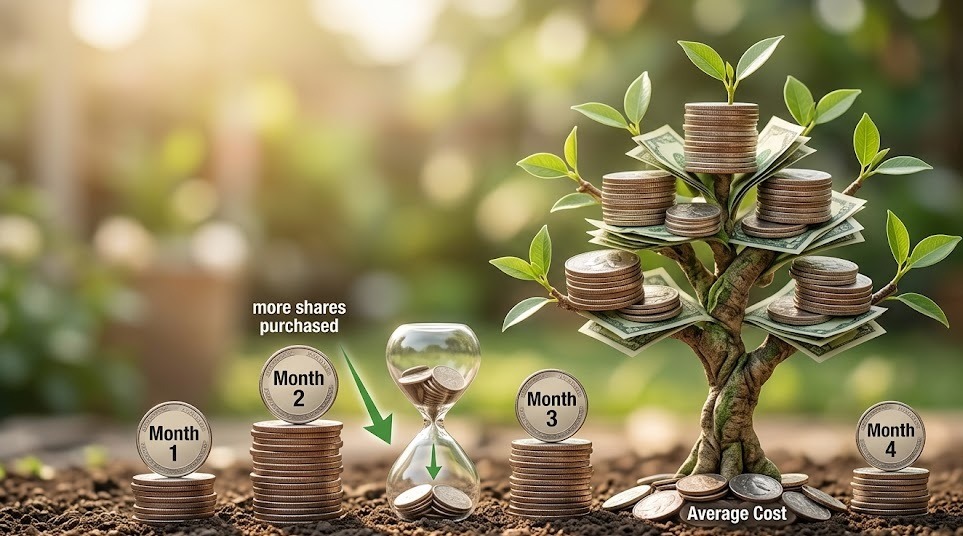
To see this in action, let’s look at how your money works over a four-month period when the market experiences a temporary drop and recovery:
Month 1: You invest $\$100$ at a share price of $\$20$. You get 5.0 shares.
Month 2: The market drops. You invest $\$100$ at a share price of $\$10$. You get 10.0 shares.
Month 3: The market recovers slightly. You invest $\$100$ at a share price of $\$15$. You get 6.6 shares.
Month 4: The market hits a new peak. You invest $\$100$ at a share price of $\$25$. You get 4.0 shares.
The Final Result:
In total, you invested $\$400$ over four months and accumulated $25.6$ shares.
If you calculate your average cost per share, it comes out to just $\$15.62$ ($\$400 \div 25.6$). Notice how your average cost is much lower than the final peak price of $\$25$, thanks to the extra shares you scooped up when the market was down in Month 2.
Why DCA Wins: The Key Benefits
Eliminates Emotional Investing: Fear and greed drive bad financial decisions. DCA automates your investments, forcing you to buy during market downturns when most people panic and sell.
No "Market Timing" Required: You don’t need to spend hours analyzing charts or following financial news. It saves you time and mental energy.
Perfect for Beginners: You don't need a massive pile of cash to start. Anyone can build a portfolio by starting with small, manageable monthly amounts.
The Catch: When is DCA Not Ideal?
While DCA is fantastic for risk management, it does have a couple of limitations:
In a Perpetual Bull Market: If an asset's price goes up indefinitely without ever dropping, investing all your money upfront (Lump-Sum investing) would yield higher returns than breaking it into pieces.
Transaction Fees: If your broker charges high flat fees for every single trade, investing small amounts frequently can eat into your profits. (Tip: Use low-cost or zero-commission brokers for DCA).
The Bottom Line
Dollar-Cost Averaging is a marathon, not a sprint. It shifts your focus from short-term market noise to long-term wealth creation. If your goal is to build a retirement fund or a long-term portfolio without the stress of watching the daily tickers, DCA is one of the most reliable strategies you can adopt.

Capital at Risk. Investing involves risk. The content of this site is for informational and educational purposes only and does not constitute investment advice.
Copyright © 2026 AevumX Capital | All rights reserved.