Your Ultimate Guide to Stocks & Global Markets
A History of Crashes
The Moments Wall Street Held Its Breath
5/10/2026
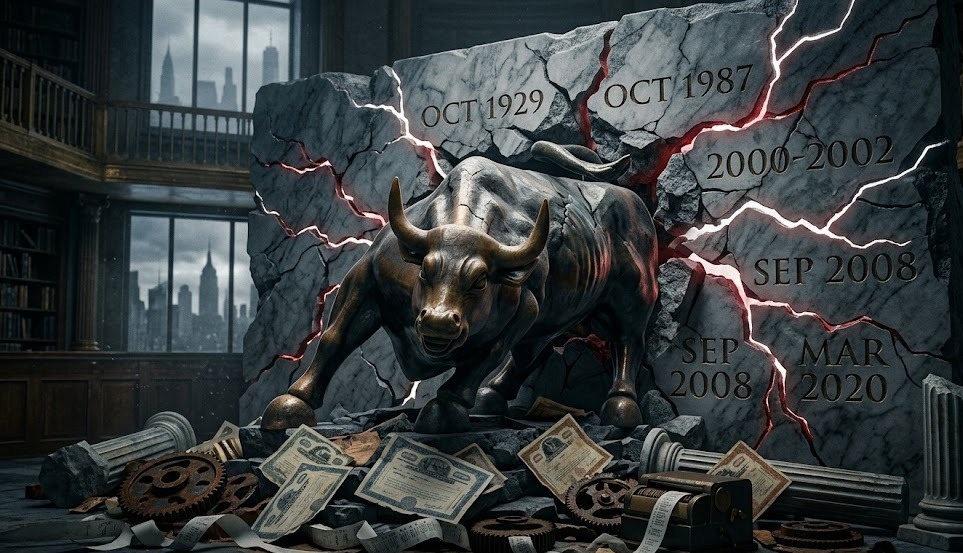
The history of the American stock market is not merely a trajectory of continuous growth and profitability, but also a chronicle of abrupt plunges that redefined the global economy. It all began with the now-legendary Crash of 1929, a catastrophe etched in history as "Black Tuesday." It was the climax of a period of reckless speculation where the price bubble burst with such violence that it led the country and the world into the Great Depression, forever changing the way the state intervenes in the economy.
For decades, the market seemed to have learned its lesson, until the arrival of Black Monday in October 1987. In a single day, the Dow Jones recorded the largest percentage drop in its history, losing over 22% of its value. The paradox of that crisis was that it wasn't triggered by a war or economic collapse, but by the introduction of early automated trading systems, which created a chain reaction of selling that no one could stop.
At the turn of the new millennium, enthusiasm for technology created the "Dot-com Bubble." Investors poured massive sums into internet companies that often had no profits to show. When reality knocked on the door in 2000, the Nasdaq index began a freefall that lasted two years, wiping out trillions of dollars in capitalization and teaching the market that technology is no guarantee of eternal growth.
A few years later, in 2008, the crisis returned in the form of subprime mortgages. The collapse of Lehman Brothers in September of that year triggered a global financial crisis that brought the banking system to the brink of total disintegration. Massive government bailouts were required to avoid a second 1929, leaving behind a deep distrust of financial institutions.
More recently, in 2020, the market faced an entirely different enemy: the COVID-19 pandemic. Uncertainty about the future and the sudden "freezing" of global activity led to a violent crash in March of that year. Although the recovery was impressively fast due to unprecedented support from central banks, the event served as a reminder that markets remain vulnerable to unpredictable external factors. Each of these events, despite the pain caused, served as a harsh lesson in resilience, leading to new regulations and a more mature approach to investment risk.
Capital at Risk. Investing involves risk. The content of this site is for informational and educational purposes only and does not constitute investment advice.
Copyright © 2026 AevumX Capital | All rights reserved.